

Board Performance · 2025
In this section14 topics
- Compliance Monitoring — Overview2 items
- Prevention of Conflicts of Interest4 items
- Prevention of the Use of Inside Information4 items
- Anti-Corruption5 items
- Whistleblowing4 items
- Selection of Directors & Chief Executives8 items
- Selection of Independent Directors2 items
- Director Development3 items
- Evaluation of Board & Subcommittee Performance3 items
- Subcommittees1 item
- Meeting Attendance & Remuneration4 items
- Supervision of Subsidiaries & Associated Companies5 items
- Board Duty Performance — Overview1 item
- Audit Committee Duty Performance1 item
Compliance Monitoring — Overview
Compliance Monitoring — Introduction
The Company ensures continuous monitoring and oversight of compliance with its corporate governance policies and practices to ensure that the Company’s operations are conducted with transparency, integrity, and in compliance with applicable laws, regulations, and relevant requirements, as well as the principles of good corporate governance for listed companies.
Relevant functions are responsible for monitoring and reviewing compliance with such policies and practices on a regular basis and reporting the results to the Board of Directors, enabling the Board to effectively oversee and supervise the Company’s operations.
In 2025, the Company continuously monitored compliance with its corporate governance policies and practices and found no cases of non-compliance.
Monitoring of Compliance with Other CG Policies & Guidelines
The Company recognizes importance of Good Corporate Governance by setting up the relevant policy and guidelines prescribed in the Corporate Governance & Code of Conduct Policy of the Company as well as encouraging for actual implementation to create trust to all stakeholders.
In 2025, the Company has monitored the performance on practices following Good Corporate Goverenance covering the following matters:
1) Employee Treatment and Equitability
2) Anti-unfair Trade Practices
3) Environment, Occupational Health and Safety in the Organization
4) Information Security.
The results shown that the Company has been completely aligned with the guidelines of each aspect.
In addition, during 2025, there were no violations of regulations issued by regulatory authorities in relation to compliance with other corporate governance policies and practices.
Prevention of Conflicts of Interest
Introduction
The Company places great importance on good corporate governance and has established a conflict of interest prevention policy to ensure that directors, executives, and employees at all levels perform their duties with integrity, transparency, and in the best interests of the Company. In cases where any individual has an interest or is involved in a matter under consideration, such person is required to disclose the information to the responsible unit overseeing such matters and refrain from participating in the consideration, decision-making, or approval of the transaction in order to prevent any conflict of interest.
In addition, the Company has established an internal control system and review procedures carried out by the Internal Audit Department to examine and monitor transactions that may involve related persons. The Company also encourages employees and stakeholders to report any concerns or suspected misconduct through the Company’s whistleblowing channel, allowing for proper investigation and appropriate actions to be taken.
Has the Company Acted to Prevent Conflicts of Interest?
Yes
Operations in the Past Year
The Company places great importance on good corporate governance and transparent business operations. The Company has established policies and guidelines on the prevention of conflicts of interest to ensure that directors, executives, and employees at all levels perform their duties with integrity, transparency, and in the best interests of the Company. Any person who has an interest in a matter under consideration is required to disclose such interest to the responsible unit and refrain from participating in the consideration and approval of such matter.
The Company requires all directors, executives, and employees to acknowledge and comply with the conflict of interest policy and to submit an annual declaration of interests. Such declarations are submitted to the Company Secretary for compilation and reporting to the Chairman of the Board of Directors and the Chairman of the Audit Committee for acknowledgement. In addition, the Company requires a review and reporting of conflicts of interest at least once a year. In the past year, all directors, executives, and employees completed and submitted the declarations, representing 100% compliance.
With regard to transactions that may give rise to conflicts of interest, the Company has clearly established procedures for the consideration and approval of related party transactions. The responsible unit conducts an initial assessment of such transactions, including reviewing their necessity, reasonableness, and fairness of terms or pricing. The Company may also appoint independent experts to provide additional opinions when appropriate. Directors or executives who have an interest in the transaction will abstain from participating in the consideration and approval process. The Audit Committee also reviews such transactions to ensure that they are conducted transparently, fairly, and in accordance with good corporate governance principles.
To further strengthen corporate governance practices, in 2025 the Company revised its Code of Business Conduct in relation to conflicts of interest by introducing additional guidelines and reporting formats for directors, executives, and employees from manager level up to assistant managing director level through an electronic system (Google Form) to enhance the efficiency of monitoring, review, and systematic record keeping. The Board of Directors approved the revision on November 12, 2025.
In addition, the Company monitored and reviewed potential conflict of interest cases by requiring directors, executives, and employees at all levels to submit reports through the Google Form system in October 2025. The review concluded that no transactions or actions were identified as conflicts of interest.
Number of Conflict-of-Interest Cases
| Metric | Current Year | Previous Year | Two Years Ago |
|---|---|---|---|
| Total number of cases or issues related to conflicts of interest (cases) | 0 | 0 | 0 |
Prevention of the Use of Inside Information
Introduction
The Company places great importance on the proper management of inside information in compliance with applicable laws, regulations, and the principles of good corporate governance. The Company has established clear written guidelines in key corporate documents, such as the Code of Business Conduct for directors, executives, and employees, as well as the Roles and Responsibilities Manual for directors, executives, and employees. These documents are provided to all directors, executives, and employees upon commencement of their duties to ensure that they acknowledge and strictly comply with the Company’s policies.
The Company has established policies and key guidelines to control the use of inside information in order to prevent the misuse of such information for personal gain or for the benefit of others. The key principles are summarized as follows:
The Company requires directors and executives to acknowledge the relevant notifications of the Office of the Securities and Exchange Commission (SEC), which require directors and executives to report any changes in their shareholdings in the Company to the SEC in accordance with Section 59 of the Securities and Exchange Act B.E. 2535 (1992) within three business days from the date of such change. In addition, directors and executives must inform the Company Secretary of such changes so that records can be maintained and a summary of the shareholding changes of directors and executives can be prepared and reported to the Board of Directors at the next Board meeting. The Company has also informed them of the legal penalties and internal disciplinary actions in the event of non-compliance with such requirements.
The Company also prohibits directors, executives, and employees from disclosing financial information or any other information that may affect the Company’s share price and has not yet been disclosed to the public to external parties or unrelated persons. In addition, they are prohibited from trading the Company’s securities during the one-month period prior to the disclosure of financial statements or other significant information that may affect the Company’s or the Group’s share price. They must also refrain from trading the Company’s securities for at least 24 hours after such information has been publicly disclosed.
Failure to comply with these requirements will be considered a violation of the Company’s disciplinary rules. Any person who violates the policy may be subject to disciplinary actions in accordance with the Company’s regulations, ranging from a warning, wage deduction, suspension without pay, to termination of employment. These policies and guidelines have been approved by the Board of Directors, and the Company has communicated them to all personnel to ensure strict compliance.
Has the Company Acted to Prevent the Use of Inside Information?
Yes
Operations in the Past Year
The Company has established a policy governing the use of inside information and securities trading by directors, executives, and persons who possess or have access to inside information, including related persons or close associates. The policy aims to prevent the misuse of the Company’s inside information for personal gain or for the benefit of others. The Company has disseminated such policy through its intranet system to ensure that all relevant parties can access and comply with it consistently.
In addition, the Office of the Company Secretary regularly sends advance notifications via email to relevant persons on a quarterly basis, totaling four times per year, regarding the Company’s securities trading blackout period (Quiet Period). This is to ensure that directors, executives, and related persons are informed and strictly comply with the Company’s policy.
The Company requires persons who possess inside information to refrain from trading the Company’s securities during the period of one month prior to the disclosure of the Company’s financial statements or information regarding the Company’s financial position and operating results to the public. Such persons are also required to refrain from trading the Company’s securities for at least 24 hours, or 48 hours in the case of complex information, after such information has been disclosed to the public. In addition, trading is prohibited during any period in which the Company possesses other material information that has not yet been disclosed to investors.
In 2025, the Company continuously monitored compliance with the aforementioned policy and did not find any instance where directors or executives traded the Company’s securities during the designated blackout period. This was supported by regular communication and reminders through the internal email system, as well as the promotion of awareness among directors, executives, and employees regarding the Code of Conduct on confidentiality, integrity, and availability of information, including strict adherence to practices related to the use of inside information in securities trading.
Reporting of Securities Trading
Regarding the reporting of securities trading by the Board of Directors and executives, the Company has formally notified them of their obligations to report their securities holdings to the Securities and Exchange Commission in accordance with Section 59 of the Securities and Exchange Act B.E. 2535 (1992). The Company also submits a report to the Board of Directors each time there is a purchase, sale, transfer, or receipt of transfer of the Company’s securities.
During 2025, directors and executives of the Company conducted a total of 11 securities trading transactions and fully complied with the Company’s policies. Directors and executives also reported their securities holdings by comparing increases (decreases) as of the book closing date between 30 December 2025 and 30 December 2024.
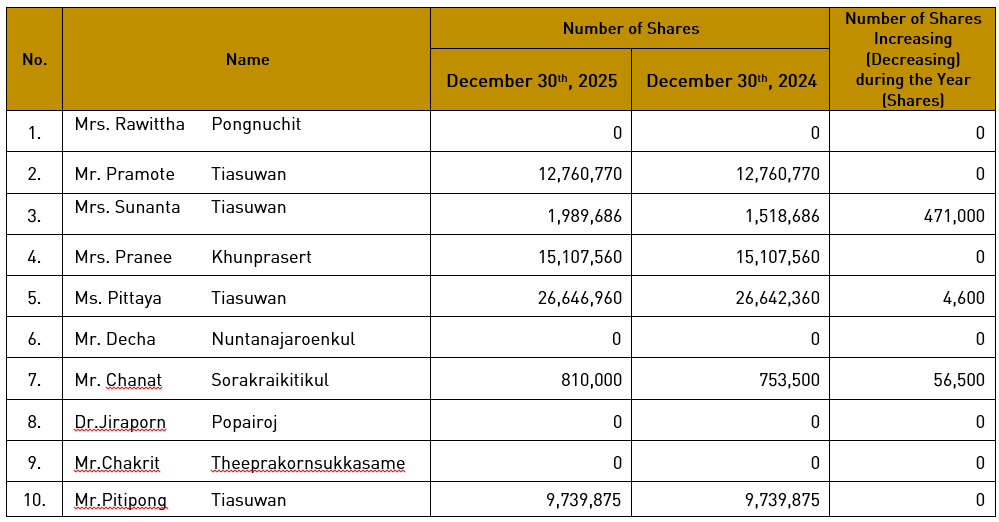
Number of Inside-Information Cases
| Metric | Current Year | Previous Year | Two Years Ago |
|---|---|---|---|
| Total number of cases or issues related to the use of inside information to seek benefits (cases) | 0 | 0 | 0 |
Anti-Corruption
Introduction
The Company is committed to conducting its business with integrity, transparency, and social responsibility. It adheres to the principles of good corporate governance, the Code of Business Conduct, and fair treatment of all stakeholder groups. The Company also demonstrates a strong commitment and determination to combat corruption in all forms.
The Company declared its intention to participate in the Collective Action Coalition Against Corruption (CAC) on 9 November 2010 and was certified as a member of the program on 9 March 2017. The Company has subsequently received its third certification renewal and submitted the self-assessment for the certification renewal on 11 December 2025.
The Company has implemented its anti-corruption policy as follows:
(1) The Company continuously communicates its anti-corruption policy and guidelines to directors, executives, and employees at all levels. All business operations are required to strictly comply with applicable laws, regulations, and related requirements. In the event that any operational errors occur due to negligence or lack of awareness, the Company will proceed in accordance with legal procedures in a transparent manner and does not support or tolerate any inappropriate actions intended to evade legal responsibility.
(2) The Company has established whistleblowing channels for reporting suspected violations of the policy or any actions that may constitute corruption. Measures are also in place to protect whistleblowers to ensure that individuals who report concerns are protected and treated fairly.
Details of the Company’s anti-corruption policy and preventive measures are disclosed on the Company’s website at www.pranda.com under the “Investor Relations” section, under “Corporate Governance,” to ensure that stakeholders can access the information and use it as appropriate guidance.
Has the Company Acted on Anti-Corruption?
Yes
Operations in the Past Year
To ensure the effectiveness of anti-corruption efforts, the Company has established processes and practices covering governance, risk management, and continuous monitoring and evaluation as follows:
1. Review of the appropriateness of anti-corruption policies and measures
The Company regularly reviews the appropriateness of its anti-corruption policy and measures to ensure compliance with relevant laws, regulations, and requirements, as well as good corporate governance practices. Such reviews cover operational processes, practices, and internal control measures related to corruption risks. The results are then proposed to the Board of Directors for consideration and approval. The most recent approval was granted on 12 November 2025.
2. Corruption risk assessment and identification The Company assesses and identifies corruption risks within its key business processes by considering potential risk factors arising from business operations, interactions with government agencies, business partners, and stakeholders. Appropriate control measures and risk management approaches are then established. Such risk assessments are conducted in conjunction with the Company’s overall enterprise risk management process.
3. Communication and training on anti-corruption policies The Company places importance on communicating and promoting awareness of anti-corruption policies and guidelines among directors, executives, and employees at all levels on a continuous basis. This is carried out through various channels, including the Company’s intranet system, the Code of Business Conduct, internal meetings, and training sessions or activities designed to enhance understanding of proper practices.
4. Monitoring and evaluation of policy compliance The Company continuously monitors and evaluates compliance with its anti-corruption policies and guidelines. Relevant departments are required to report operational results, including any complaints or suspicions of misconduct that may constitute corruption, through established whistleblowing channels so that the Company can conduct appropriate investigations and implement corrective actions where necessary.
5. Review of the adequacy of related processes The Audit Committee is responsible for overseeing and reviewing the adequacy of the Company’s internal control system, including processes related to the prevention of corruption. This review takes into consideration reports from the internal audit function as well as information from the external auditor to ensure that the Company maintains appropriate control measures to effectively prevent corruption risks.
Form of Anti-Corruption Operations
| Operation |
|---|
| Review of appropriateness in anti-corruption |
| Assessment and identification of corruption risk |
| Communication and training for employees on anti-corruption policy and guidelines |
| The monitoring of the evaluation of compliance with the anti- corruption policy |
| Review of the completeness and adequacy of the process by the Audit Committee or auditor |
Number of Corruption Cases
| Metric | Current Year | Previous Year | Two Years Ago |
|---|---|---|---|
| Total number of cases or issues related to corruption (cases) | 0 | 0 | 0 |
Whistleblowing
Introduction
The Company has established channels for receiving complaints and whistleblowing reports from all stakeholder groups regarding any improper or inappropriate conduct that may cause damage to the Company or the Group. This includes violations of laws, the Company’s rules and regulations, the Code of Business Conduct, inaccurate financial reporting, as well as deficiencies in the Company’s internal control system. Whistleblowers or complainants are required to provide truthful information and must not make accusations against others without sufficient supporting evidence. The Company has also implemented measures to protect whistleblowers who report matters in good faith in order to prevent any potential adverse impacts on them.
The Company has provided multiple channels for submitting whistleblowing reports and complaints, including email, telephone, and suggestion and complaint boxes, in order to facilitate stakeholders in reporting information. The Audit Committee, which operates independently from management, is responsible for considering such complaints. The Company Secretary has been assigned to collect information and documentation received through these channels and summarize key issues and recommendations for submission to the Board of Directors on a quarterly basis.
In cases where letters or complaints are addressed directly to the Audit Committee, such matters will be forwarded directly to the Audit Committee for consideration. In urgent cases, whistleblowers may also report directly to the Group Executive Chairman via email at pranee@pranda.co.th
After receiving a complaint or whistleblowing report, the Company will conduct an investigation in accordance with established procedures and maintain written records of the investigation while keeping the identity of the whistleblower confidential. All whistleblowing information will be treated with strict confidentiality in order to protect the whistleblower from any potential adverse consequences.
Whistleblowers may submit complaints or information to the Board of Directors through the Company Secretary, or to the Audit Committee through the Secretary to the Audit Committee, which operates independently, as well as to relevant responsible units that coordinate with stakeholders. Reports may be submitted through any of the channels deemed appropriate under the circumstances, as follow
Providing protection for whistleblowers and related persons
The complainant or the whistleblower will receive appropriate and fair protection from the company, such as no change in job position or demotion, job description, workplace, suspension, intimidation, interference with work, termination, or any other unfair action against the complainant or the whistleblower. For information about the complaint, the company will keep it confidential and not disclose it to unrelated persons, except when it is necessary to disclose it according to the requirements of the law. The related persons who are aware of the matter or information related to the complaint must keep the information confidential and not disclose it to other persons. If there is an intentional violation by disclosing the information, the company will take disciplinary action according to the company's regulations and/or take legal action, as the case may be.
Has the Company Implemented Whistleblowing Procedures?
Yes
Operations in the Past Year
In 2025, the Company enhanced its complaint handling and whistleblowing system to improve the effectiveness of receiving feedback and complaints from all stakeholder groups.
The Company also reviewed and expanded its communication channels for whistleblowing and complaints in order to ensure broader accessibility.The Company introduced additional whistleblowing channels through dedicated email contacts of relevant departments responsible for different stakeholder groups. These include departments responsible for customers, business partners, and other related functions. This initiative is intended to facilitate stakeholders in submitting complaints or information directly to the responsible units. It also enables stakeholders to select the most appropriate communication channel based on the circumstances, thereby improving accessibility, responsiveness, and overall efficiency in handling complaints. Such actions form part of the Company’s efforts to promote transparency in business operations and to encourage stakeholders to participate in monitoring and reporting any conduct that may constitute fraud, violations of company policies, or other inappropriate behavior that could potentially affect the Company.
In 2025, the Company did not receive any complaints or whistleblowing reports related to corruption, fraud, or violations of the Company’s Code of Business Conduct.
Number of Whistleblowing Cases
| Metric | Current Year | Previous Year | Two Years Ago |
|---|---|---|---|
| Total number of cases or issues received through whistleblowing channels (cases) | 0 | 0 | 0 |
Selection of Directors & Chief Executives
Selection — Introduction
The Nomination Committee is a sub-committee appointed by the Board of Directors with the responsibility for identifying, selecting, and screening qualified individuals for nomination to the Board of Directors or the shareholders’ meeting for appointment as directors of the Company. The objective is to ensure that the Board of Directors has an appropriate composition and is able to effectively perform its duties in overseeing the Company’s operations and determining its strategic direction.
In carrying out the nomination process, the Nomination Committee considers candidates from various sources, including recommendations from existing directors, nominations proposed by shareholders in accordance with applicable laws, recruitment through professional search firms, candidates from director pools maintained by relevant organizations, as well as other channels deemed appropriate by the Nomination Committee. This approach helps ensure that individuals with suitable knowledge, expertise, and experience relevant to the Company’s business are considered.
In nominating new directors, the Nomination Committee takes into account not only the qualifications required by applicable laws and regulations but also the overall composition of the Board of Directors. Key considerations include the appropriate number of directors relative to the Company’s size and business nature, the proportion of independent directors, board diversity, as well as the knowledge, expertise, and experience that align with the Company’s strategic direction and business operations.
To ensure a systematic and comprehensive evaluation, the Nomination Committee utilizes a Board Skill Matrix as a tool to assess the skills, knowledge, and experience of the current Board members, and to identify additional qualifications or competencies that may be required for future director nominations. This helps ensure that the Board of Directors maintains a balanced composition of skills and expertise appropriate for the effective oversight of the Company’s business.
During 2025, the Nomination Committee performed its duties with due care and diligence in accordance with its assigned roles and responsibilities. The Committee reviewed the structure of the Board of Directors, assessed the appropriateness of the Board composition, and carefully considered the qualifications of nominated candidates before making recommendations to the Board of Directors and the shareholders’ meeting for approval in accordance with the established procedures. This process ensures that the nomination of directors is conducted in a transparent and fair manner and in line with the principles of good corporate governance.
Directors & Chief Executives — Introduction
Director Nomination
The Company places great importance on the nomination and appointment of directors to ensure that the Board of Directors has an appropriate composition that is consistent with the size, nature, and complexity of the Company’s business. The Board should possess a diverse range of knowledge, capabilities, and professional experience that supports effective corporate governance and strategic direction.
The Company has assigned the Nomination and Remuneration Committee to be responsible for the nomination process. The Committee is tasked with identifying, considering, and screening qualified candidates for nomination as directors. The Nomination and Remuneration Committee consists of three members, including two independent directors, ensuring that the nomination process is conducted with transparency, independence, and in accordance with good corporate governance principles.
In considering candidates for directorship, the Nomination and Remuneration Committee evaluates the suitability of nominees by taking into account the structure, size, and overall composition of the Board of Directors, as well as the knowledge, expertise, experience, and skills required for the Company’s business operations. The objective is to ensure that the Board comprises professional directors with diverse backgrounds and competencies (Board Diversity).
As the Company operates in the jewelry and gemstone industry, the Nomination and Remuneration Committee also places emphasis on identifying individuals who possess knowledge, understanding, or relevant experience in the industry, as well as the capability to contribute to effective corporate governance and long-term strategic direction.
After completing the screening process, the Nomination and Remuneration Committee will propose qualified candidates to the Board of Directors for consideration and approval. The nominated candidates will then be submitted to the Shareholders’ Meeting for election in accordance with applicable laws and the Company’s Articles of Association.
In the election of directors, each director shall be elected individually and must receive more than half of the total votes of shareholders present at the meeting and entitled to vote, in accordance with the Public Limited Companies Act.
In addition, the Company provides an opportunity for shareholders, particularly minority shareholders, to propose qualified candidates for nomination as directors in advance of the Annual General Meeting, in accordance with the criteria specified by the Company and disclosed on the Company’s website. This practice aims to promote shareholder participation and enhance transparency in the director nomination process.
Nomination of the Chief Executives
The Company recognizes the importance of the nomination and appointment of the Chief Executives to ensure that the appointed individual possesses the knowledge, competencies, skills, and experience necessary to effectively manage the Company and achieve its strategic objectives.
The Board of Directors has assigned the Nomination and Remuneration Committee to establish the criteria and procedures for the nomination of the Chief Executives. The Committee is responsible for identifying, evaluating, and screening qualified candidates and proposing more than one candidate, together with supporting rationale, to the Board of Directors for consideration and appointment.
In evaluating potential candidates, the Nomination and Remuneration Committee considers various factors, including qualifications, professional knowledge, leadership capability, management skills, and relevant experience, as well as the candidate’s understanding of the Company’s business and industry.
This process ensures that the appointed Chief Executives is capable of effectively leading the organization and driving the Company to achieve the vision, objectives, and strategic goals established by the Board of Directors.
Selection Process — Introduction
The Company places significant importance on the nomination and appointment process of the Board of Directors and the Chief Executive Officer to ensure that the individuals appointed possess appropriate qualifications, knowledge, capabilities, and experience. This enables them to effectively supervise and manage the organization in alignment with the principles of good corporate governance for listed companies.
Director Selection Criteria
The Company has assigned the Nomination and Remuneration Committee to be responsible for identifying, screening, and nominating qualified candidates for appointment as directors or the Chief Executive Officer.
The nomination process is conducted in a structured, transparent, and systematic manner in compliance with applicable laws, regulations, and relevant best practices before being proposed to the Board of Directors or the shareholders’ meeting for consideration and appointment, as the case may be.
The Company has also established clear nomination procedures to ensure that the selection of candidates is appropriate, transparent, and capable of supporting the Company’s business operations as well as its corporate governance practices effectively.
Director Nomination Process
The Nomination and Remuneration Committee establishes the framework and criteria for the nomination of directors to ensure that nominated candidates possess the appropriate qualifications and capabilities to perform their duties in accordance with the principles of Fiduciary Duty, namely the Duty of Care and the Duty of Loyalty.
In considering candidates for directorship, the Committee evaluates the overall composition and structure of the Board of Directors, including Board Diversity, as well as the qualifications, knowledge, expertise, and skills required for the Company’s business operations.
In addition, the Nomination and Remuneration Committee utilizes a Board Skills Matrix as a key tool to assess the competencies, knowledge, and experience of the Board members. This ensures that the Board maintains an appropriate balance of expertise and enables the Company to identify any additional competencies or expertise required to further enhance the effectiveness of the Board of Directors. The Company has established the following procedures for the nomination of directors:
1. Selection of directors to replace directors whose terms have expired
The consideration guidelines are as follows:
1.1 Providing an opportunity for minority shareholders to propose names of suitable directors for the Nomination and Remuneration Committee to consider.
1.2 Nominating persons with suitable qualifications to be considered for election as directors of the Company by the Nomination and Remuneration Committee by submitting a list of names to the Board for consideration in an amount greater than the number of directors to be selected, so that the Board has the opportunity to select the most suitable directors. Propose to the shareholders' meeting for consideration according to the number of appointments, which may be considered from the selection by external consultants (Professional Search Firm), selection from the Director's Pool of various agencies, or selection by other processes that the Selection and Remuneration Committee deems appropriate.
1.3 Qualifications of directors as specified by the Company in the "Guide to Good Corporate Governance and Business Ethics" under the topic of Board Structure, including qualifications in accordance with relevant laws and regulations, namely the Public Limited Companies Act B.E. 2535, the Securities and Exchange Act B.E. 2535, the Capital Market Supervisory Board's announcement, the Corporate Governance Principles for Listed Companies 2017 (CG Code) of the Securities and Exchange Commission (SEC), as well as the criteria and regulations of the SEC and the Stock Exchange of Thailand.
1.4 The Company's regulations and the Guide to Good Corporate Governance and Business Ethics
1.5 Other laws and regulations related to the qualifications of directors in listed companies
1.6 Interests and potential conflicts of interest with the Company
1.7 Consider the appropriateness and diversity of knowledge, experience, and specialized skills that are beneficial to the Company with experience in the main business or industry in which the Company operates.
To ensure that the Board of Directors has the specified composition by creating a Board skills matrix, including knowledge of the Company's business, corporate governance, strategy and restructuring, international business marketing, technology and information, law, social responsibility and sustainable development, risk and crisis management, accounting and finance, internal audit, etc.
1.8 The diversity of the composition of the Board of Directors includes gender, race and nationality diversity without limitations on gender, race, nationality, skin color, ethnicity or religion, including the proportion of independent directors that is appropriate in accordance with the principles of good corporate governance.
1.9 In the event of a proposal to appoint an independent director, additional consideration will be given to the qualifications of independence, which are consistent with the announcement of the Capital Market Supervisory Board and the definition of the qualifications of the Company's independent directors. In the event that the original independent director will return to the position, the term of office should not exceed 9 years from the date of the first appointment as an independent director. In the event that the independent director is to be appointed to continue the position The Nomination and Remuneration Committee shall reasonably consider the necessity.
1.10 In the case of a proposal to appoint the same director, the performance results during the term of office shall be considered, including the number of companies that each director may hold positions in, not exceeding 5 listed companies, as well as the provision of useful suggestions and opinions for the Company's operations, the dedication of sufficient time to perform duties as a director of the Company, and the participation in various activities of each director, in addition to those specified above.
1.11 Consent of the person nominated to hold the position of director of the Company
2. Recruitment of a director to replace a vacant position due to reasons other than retirement by rotation
The consideration guidelines are as per clause 1, except clauses 1.1 and 1.10.
Criteria for Selecting Chief Executives
The Board of Directors has considered and assigned the Nomination and Remuneration Committee to consider the criteria and methods for selecting individuals with suitable qualifications to hold the position of top executives and to propose more than one person, along with reasons, for the Board of Directors to consider appointing. In the selection process, the Board of Directors has considered and screened individuals with complete qualifications, appropriate knowledge, skills, and experience that are beneficial to the Company’s operations, and have a good understanding of the Company’s business and are able to manage the Company to achieve the objectives and goals set by the Board of Directors.
Qualifications of Chief Executives
1. Characteristics
1) Integrity and accountability
2) Informed judgment
3) Maturity and stability, a good listener who dares to express different opinions and is independent
4) Adheres to working with principles
2. Knowledge and ability in business operations, skills, experience, professions, and specific qualifications in various fields that are essential and of the greatest benefit to the Company’s business
3. Qualifications according to the criteria set by the Securities and Exchange Commission and the Stock Exchange of Thailand
4. Experience in the jewelry and gemstone business and organizational management that will enhance the Company’s operational efficiency and competitive potential
5. Experience in leading the organization Have high leadership
6. Recognized by relevant business organizations
7. Approved by the board of directors
8. Consider conflicts of interest
Chief Executive Selection Process
1. The selection and remuneration committee considers selection and screens according to the qualifications of the chief executives.
2. Proposes the list of selected persons to the board of directors' meeting for consideration and approval of appointment by a majority vote of the number of directors attending the meeting.
Are Directors Selected Through the Nomination Committee?
Yes
Are Chief Executives Selected Through the Nomination Committee?
Yes
Number of Directors from Major Shareholders
0
Rights of Minority Shareholders on Director Appointment
The Company places great importance on the protection of shareholders’ rights and the equitable treatment of all shareholders in accordance with the principles of good corporate governance. The Company provides opportunities for shareholders, particularly minority shareholders, to participate in the Company’s corporate governance process, including the nomination of qualified individuals for consideration and appointment as directors of the Company.
Director Nomination by Shareholders
The Company allows a single shareholder or several shareholders holding shares in aggregate of not less than 5 percent of the Company’s total voting rights to propose qualified individuals for consideration and nomination as directors in advance of the Annual General Meeting of Shareholders.
The Company opens the nomination period annually, allowing shareholders to submit director nominations in advance of the Annual General Meeting during the period from October to December each year. This enables the Nomination and Remuneration Committee to appropriately review and screen the qualifications of the nominated candidates before proposing them to the Board of Directors for further consideration.
Nomination Criteria and Submission Channels
The nomination of individuals for consideration as directors, as well as the proposal of agenda items for the shareholders’ meeting, must comply with applicable laws, the Company’s Articles of Association, and the criteria established by the Company.
The Company publishes the relevant criteria, procedures, and nomination forms on the Company’s website to facilitate shareholders in exercising their rights conveniently and transparently.
Voting Method for Director Appointment
The appointment of directors is subject to consideration and approval by the shareholders’ meeting. Shareholders vote to elect directors on an individual basis, and the person receiving more than half of the total votes of the shareholders present at the meeting and entitled to vote shall be appointed as a director.
Such voting procedure is conducted in accordance with the Public Limited Companies Act and the Company’s Articles of Association.
Method of Director Appointment
| Method |
|---|
| Method whereby each director requires approval votes more than half of the votes of attending shareholders with voting rights |
Selection of Independent Directors
Criteria for Selecting Independent Directors
The Company establishes criteria for the nomination of Independent Directors to ensure that the Board of Directors has an appropriate composition and is able to effectively perform its oversight duties with transparency and in accordance with the Corporate Governance Code for Listed Companies.
The nomination of Independent Directors is undertaken by the Nomination and Remuneration Committee, which is responsible for identifying and selecting qualified candidates in compliance with the qualifications prescribed by the Securities and Exchange Commission (SEC). The Committee will then propose the nominated candidates to the Board of Directors and/or the Shareholders’ Meeting for consideration and appointment in accordance with the prescribed procedures.
Qualifications of Independent Directors
Individuals nominated to serve as Independent Directors must possess the qualifications and must not have any prohibited characteristics as prescribed by applicable laws and regulatory requirements. The key qualifications are as follows:
Holding no more than 1% of total voting shares of the Company, the Parent Company, Subsidiaries, Associates, major shareholders or controlling parties of the Company. Thus, the shareholding of persons related to the Independent Director shall also be included.
Not currently be or never been the Executive Director, worker, employee, salaried consultant or controlling parties of the Company, Parent Company, Subsidiaries, Associates, Subsidiaries in similar level, major shareholder or controlling parties of the Company, unless the status has been terminated at least 2 years prior to the date of submitting the permission to the Securities and Exchange Commission (SEC). Thus, such prohibition shall not include the case that the Independent Director used to be an official or advisor to the government sector which are major shareholders or controlling parties of the Company.
Not by blood or legally registered in the status of father, mother, spouse, brother and sister and child including spouse of son or daughter of the management, major shareholders, controlling parties or persons who will be nominated as the Executives or controlling parties of the Company or Subsidiaries.
Not currently having or never had any relations with the Company, Parent Company, Subsidiaries, Associates, major shareholder or controlling parties of the Company in the way that such relation may impede the person from having independent views. Also, the person should not currently be or never be a significant shareholder or controlling person having business relations with the Company, Parent Company, Subsidiaries, Associates, major shareholder or controlling parties of the Company, unless the status has been terminated at least 2 years prior to the date of submitting the permission to the Securities and Exchange Commission (SEC). The term “Business Relationship” shall include normal business transactions on rental or lease of immovable property, transactions related to assets or services or giving or receiving financial assistance through loans, guarantees, providing assets as collateral as well as any similar actions which results in the debts obligated by the Company or counterparties to the other parties in the amount equal to or more than 3% of the net tangible assets of the Company or equal to or more than THB 20 million; whichever is lower. Thus, the calculation of such debts shall be proceeded in accordance with the calculation method on the values of connected transactions under the Notification of the Capital Market Supervisory Board upon the conditions of connected transaction mutatis mutandis. However, determination of such debts shall include any debts incurred during the period of 1 year prior to the date of commencing business relationship with the party.
Not currently being or never been the auditor or never provided services as legal consultant or financial consultant with service fee more than THB 2 million per year from the Company, Parent Company, Subsidiaries, Associates, major shareholder or controlling parties of the Company. Also, the person should not currently be or never be a significant shareholder, controlling person or partners of current auditor’s auditing firm, unless it has been at least two years after the person has held the position prior to the date of submitting the permission to the Commission.
Not currently be providing or never provided professional services neither legal consulting nor financial consulting services to the Company with service fee more than THB 2 million per year for the Company, Parent Company, Subsidiaries, Associates, major shareholder or controlling parties of the Company. Also, the person should not currently be or never be a significant shareholder, controlling person, or partners of current service providers, unless it has been at least two years after the person has held the position prior to the date of submitting the permission to the Commission.
Not currently be a director appointed to represent the Company’s Directors, major shareholders or the shareholder who is related to major shareholder.
Not currently be operating under similar business nature and significant competition to the Company or Subsidiaries or not a significant partner of the partnership or an Executive director, salaried worker, employee or consultant or holding more than 1% of voting shares of any other companies operating under similar business nature and in significant competition to the Company and Subsidiaries.
Not under any conditions that may impede the person from having independent views towards the Company’s operations.
After the appointment as the Independent Director in accordance with the conditions under items 1 – 9, the Independent Director may be assigned by the Board of Directors to make decisions on business operations of the Company, Parent Company, Subsidiaries, Associates, Subsidiaries in the same level, major shareholders or controlling parties of the Company in form of collective decision.
Independent Director Nomination Process
The Nomination and Remuneration Committee is responsible for conducting the nomination process for Independent Directors in a systematic, transparent, and structured manner, in accordance with the principles of good corporate governance.
Potential candidates may be considered from various sources, including:
Nominations by the Board of Directors
Director nominations proposed by shareholders in accordance with applicable laws and regulations
Recommendations from professional search firms
Candidates from director pools maintained by relevant organizations
In evaluating potential candidates, the Nomination and Remuneration Committee carefully considers the qualifications, knowledge, expertise, and professional experience of the nominees, as well as their alignment with the overall Board composition.
The Committee also utilizes a Board Skill Matrix as a key tool in assessing the skills, competencies, and experience of the existing Board members. This assessment helps identify any skill gaps and supports the nomination process to ensure that the Board of Directors maintains an appropriate balance of expertise and diversity, enabling it to effectively oversee the Company’s business and strategic direction.
Following the screening and evaluation process, the Nomination and Remuneration Committee will propose qualified candidates to the Board of Directors for consideration and subsequently submit the nominations to the Shareholders’ Meeting for approval in accordance with the prescribed procedures.
Did Any Independent Director Have a Business or Professional Relationship?
No
Director Development
Director Development — Introduction
The Board of Directors places importance on the continuous development of directors’ knowledge, competencies, and skills necessary for the effective performance of their duties. This ensures that directors are able to effectively carry out their responsibilities in overseeing the Company’s operations in accordance with the principles of good corporate governance for listed companies. The Company therefore encourages and supports directors to regularly participate in training programs, seminars, and knowledge-enhancement activities relevant to their roles and responsibilities.
Most directors have attended training programs relating to directors’ duties organized by the Thai Institute of Directors Association (IOD), as well as programs and seminars organized by other reputable organizations and institutions. These programs cover topics such as corporate governance, risk management, laws and regulations relating to listed companies, and emerging business trends, which help enhance the Board’s knowledge and strengthen the effectiveness of its oversight.
Currently, 8 out of the Company’s 9 directors, representing 88.88 percent of the total number of directors, have completed director training programs organized by the Thai Institute of Directors Association (IOD), including the Director Certification Program (DCP) and the Director Accreditation Program (DAP). These programs aim to enhance directors’ knowledge and understanding of their roles, responsibilities, and corporate governance practices.
Qualifications for Director Selection — Introduction
The Company establishes criteria and qualifications for individuals to be nominated as directors to ensure that the Board of Directors comprises individuals with appropriate knowledge, capabilities, and experience. Such individuals must be able to effectively perform their duties in overseeing the Company’s operations with efficiency, transparency, and in accordance with the principles of good corporate governance for listed companies.
The qualifications of the Company’s directors are as follows:
Directors must possess knowledge, capability, experience, and expertise beneficial to the Company’s business operations. They must demonstrate integrity, honesty, and ethical conduct in business practices, and must be able to dedicate sufficient time to effectively perform their duties as directors.
Directors must not possess any prohibited characteristics as prescribed under the Public Limited Companies Act. They must also not exhibit any characteristics indicating a lack of appropriateness or reliability to manage a company with public shareholders as defined under the Securities and Exchange Act or the regulations prescribed by the Securities and Exchange Commission.
Directors must not have previously violated regulations, rules, notifications, orders, board resolutions, or agreements relating to the listing requirements of the Stock Exchange of Thailand, including any relevant circulars that may significantly affect the rights and interests of shareholders or investors, or undermine confidence in the capital market.
Directors must not operate, become a partner in, or serve as a director of any other juristic entity that engages in a business of the same nature and is in competition with the Company, whether for their own benefit or for the benefit of others, unless such matter has been disclosed to the shareholders’ meeting prior to the appointment.
Directors must maintain independence and avoid any conflicts of interest that may impair their ability to perform duties independently and exercise objective judgment in the best interests of the Company and its shareholders as a whole.
Qualifications for Director Selection
| Qualification | Skill & Expertise |
|---|---|
| The Company places importance on the diversity of skills, knowledge, and experience of the Board of Directors to ensure that the Board collectively possesses comprehensive competencies appropriate for effectively overseeing the Company’s business operations. The key skills and areas of expertise considered important are as follows: • Fashion / Design Industry Knowledge or experience in the fashion industry, product design, or lifestyle products to support product development and enhance the value of the Company’s jewelry business. • Logistics and Supply Chain Management Knowledge or experience in logistics, procurement, and supply chain management to enhance efficiency in sourcing, production, and product distribution. • Legal and Regulatory Compliance Knowledge or experience in business law, public company law, or relevant regulations to support effective corporate governance and compliance with applicable laws and regulatory requirements. • Marketing and Brand Management Knowledge or experience in marketing strategy, brand development, channel management, or consumer behavior to strengthen competitiveness and support the Company’s business growth. • Finance and Accounting Knowledge or experience in finance, accounting, financial planning, or financial analysis to support financial oversight and strategic decision-making of the Company. | 115 · Description: Fashion · 138 · Description: Transportation & Logistics · 141 · Description: Law · 142 · Description: Marketing · 144 · Description: Finance |
Evaluation of Board & Subcommittee Performance
Criteria for Evaluating Board Performance
The evaluation of the Board of Directors’ performance is conducted through assessment forms covering key aspects of good corporate governance. The main evaluation topics are as follows:
1. Board of Directors as a Whole Evaluation
The evaluation covers key areas such as:
Structure and qualifications of the Board of Directors
Roles, duties, and responsibilities of the Board of Directors
Board meetings
Performance of directors
Relationship with management
Directors’ self-development and executive development
2. Individual Director Evaluation
The evaluation covers areas such as:
Structure and qualifications of the Board of Directors
Board meetings
Roles, duties, and responsibilities of the Board of Directors
3. Sub-Committee Evaluation
The evaluation covers areas such as:
The structure and qualifications of each sub-committee, ensuring appropriateness and effectiveness in supporting the Board’s operations
Sub-committee meetings conducted on various matters to ensure that the Board can effectively perform its duties during meetings, including the effectiveness of operations within the scope of authority
Roles, duties, and responsibilities of the sub-committees, ensuring that sufficient attention and time are given to reviewing and performing their responsibilities
4. Performance Evaluation of the Chief Executive Officer (Group Chief Executive Officer)
The evaluation covers the following key areas:
Performance evaluation based on Key Performance Indicators (KPIs)
Leadership assessment
Evaluation of budget and project management
Sustainability assessment in Environmental, Social, and Governance (ESG) dimensions
Scoring Criteria
Score | Meaning |
0 | Strongly disagree or never conducted |
1 | Disagree or seldom conducted |
2 | Fair or moderately conducted |
3 | Agree or well conducted |
4 | Strongly agree or excellently conducted |
Assessment criteria
Average Score (%) | Level |
90-100% | Excellent |
80-89% | Very Good |
70-79% | Good |
50-69% | Fair |
30-49% | Needs Improvement |
Self-Evaluation Process for Individual Directors and the Board:
The company evaluates the performance of both individual directors and the entire board, including committees, every year using a self-assessment form aligned with the guidelines of the Stock Exchange of Thailand.
The company secretary distributes the self-assessment forms to each director for completion and submits the results to the Nomination and Remuneration Committee for consolidation.
The Nomination and Remuneration Committee evaluates the performance of the entire board and committees.
The evaluation results are presented to the board for review, to discuss performance, address any issues, assess the effectiveness of governance, and use the evaluation outcomes to improve management performance
Evaluation of Board Performance in the Past Year
Board of Directors’ Performance Evaluation
The Company conducts an annual performance evaluation of the Board of Directors to review the effectiveness of its corporate governance. The evaluation covers both the performance of the Board as a whole and the individual performance of each director. The Board of Directors has assigned the Nomination and Remuneration Committee to establish the evaluation criteria and oversee the evaluation process.
For the year 2025, the evaluation results indicated that the Board of Directors performed its duties effectively and in accordance with its roles, duties, and responsibilities. The Board also played an important role in setting policies and overseeing the Company’s operations in line with good corporate governance principles. The overall evaluation result of the Board of Directors was rated at an “Excellent” level. The Company will utilize the evaluation results to further enhance the effectiveness of the Board’s performance on a continuous basis.
Performance Evaluation of the Chief Executives
The Board of Directors places importance on the performance evaluation of the Chief Executive Officer to ensure that the Company’s operations align with its strategies, objectives, and good corporate governance practices. The evaluation is conducted on an annual basis.
The evaluation covers key areas including performance assessment based on the Objectives and Key Results (OKRs) framework, leadership capability, management of budgets and projects, as well as sustainability performance in the Environmental, Social, and Governance (ESG) dimensions.
For 2025, the overall evaluation result indicated that the Chief Executive Officer performed his duties effectively and in alignment with the Company’s strategies and objectives, with the overall performance rated at a “Very Good” level.
Evaluation Results
| Evaluated Body | Group — Carried Out? | Group — Grade / Average Score | Group — Grade / Full Score | Individual (Self-Assessment) — Carried Out? | Individual (Self-Assessment) — Grade / Average Score | Individual (Self-Assessment) — Grade / Full Score | Cross (Assessing Other Directors) — Carried Out? |
|---|---|---|---|---|---|---|---|
| Board Of Director | Y | 91 | 100 | Y | 90 | 100 | N |
| Audit Committee | Y | 100 | 100 | N | N | ||
| Other Subcommittee | Y | 90 | 100 | N | N | ||
| Other Subcommittee | Y | 92 | 100 | N | N | ||
| Other Subcommittee | Y | 56 | 100 | N | N | ||
| Other Subcommittee | Y | 92 | 100 | N | N |
Subcommittees
Subcommittees
| Results of the Subcommittee's Duty Performance | Meetings — Introduction |
|---|---|
In 2025, the Group Executive Committee performed its duties in determining the strategic direction and overseeing the operations of the Group to ensure alignment with the vision, strategies, and policies set by the Board of Directors. The Committee emphasized efficient and transparent management in accordance with good corporate governance principles. The key activities are summarized as follows:
Summary of the Performance Evaluation of the Group Executive Committee The Nomination and Remuneration Committee conducted the performance evaluation of the Group Executive Committee for 2025, taking into consideration its roles, duties, and responsibilities as assigned, as well as the effectiveness of its oversight and organizational management. Based on the evaluation, the Group Executive Committee was considered to have performed its duties in accordance with its defined roles and responsibilities, playing an important role in setting directions and overseeing the operations of the Group in alignment with the Company’s policies and strategies. The Committee also supported effective, transparent management practices in line with the principles of good corporate governance. | The Board of Directors has appointed the Group Executive Committee to determine the strategic direction of the Group and to oversee the Company’s operations in alignment with the vision, strategies, policies, and resolutions of the Board of Directors. The Committee is also responsible for formulating business goals, business plans, and the annual budget of the Group for submission to the Board of Directors for approval. In addition, the Committee oversees the management of resources, business development and expansion, the appointment of executives, the determination of organizational and compensation structures, as well as the monitoring of operational performance and internal control systems to ensure that the Company operates efficiently, transparently, and in accordance with good corporate governance principles. In 2025, the Group Executive Committee held a total of 12 meetings to consider and determine policies and business plans, as well as to monitor the performance of the Group. The meetings also addressed key management matters to ensure alignment with the Company’s business direction and the changing business environment. The overall attendance rate of the Committee members was 98.61% of the total meetings, reflecting their active participation in overseeing and driving the Group’s operations toward the achievement of its objectives. |
In 2025, the Nomination and Remuneration Committee performed its duties in overseeing the nomination process, board development, and remuneration determination for the Company’s directors, subcommittee members, and senior executives to ensure alignment with the principles of good corporate governance, transparency, and appropriate governance practices, while taking into consideration a management structure suitable for the size, nature, and complexity of the Company’s business. The Committee reviewed and established criteria and processes for the nomination of directors, independent directors, subcommittee members, and senior executives, taking into account their qualifications, knowledge, expertise, and experience relevant to the Company’s business operations. In addition, the Committee oversaw the development of director development programs and succession plans for senior executives to ensure business continuity and effective leadership transition. Furthermore, the Committee considered and established remuneration policies and guidelines for directors, subcommittee members, and senior executives to ensure that remuneration is appropriate, fair, and aligned with their responsibilities, the Company’s performance, and market practices. The Committee also proposed the remuneration of the Board of Directors to the Board and the shareholders’ meeting for approval. In addition, the Committee oversaw the performance evaluation process for the Board of Directors, subcommittees, and senior executives, as well as the disclosure of remuneration policies, criteria, and related information in the Company’s annual report in compliance with regulatory requirements. Summary of the Performance Evaluation of the Nomination and Remuneration Committee Based on the annual performance evaluation for 2025, the Board of Directors concluded that the Nomination and Remuneration Committee had performed its duties in accordance with its defined roles and responsibilities, effectively overseeing the nomination process, board development, and remuneration determination in a transparent and appropriate manner, while supporting effective corporate governance and organizational management. | The Board of Directors has appointed the Nomination and Remuneration Committee to oversee the nomination and selection process for directors, subcommittee members, and top executives, as well as to establish policies and guidelines for determining remuneration to ensure that it is appropriate, transparent, and aligned with the Company’s performance and good corporate governance practices. In 2025, the Nomination and Remuneration Committee held a total of two meetings to consider matters relating to the nomination of qualified individuals to serve as directors and top executives, as well as to review policies and criteria for determining remuneration for directors and senior executives. The attendance rate of the Committee members was 83.33% of the total meetings, reflecting their participation in overseeing the Company’s nomination and remuneration processes. |
The Risk Management Committee prioritizes overseeing the risk management process to ensure it covers the entire organization. This is conducted in accordance with the international standard framework (COSO Enterprise Risk Management Framework) to maintain risks at levels acceptable to the Company and to align with the principles of Good Corporate Governance. In 2025, the Committee performed its key duties, which can be summarized as follows:
The Committee reviewed the Risk Management Committee Charter to ensure it remains appropriate and up-to-date. This review aimed to define the scope, duties, responsibilities, and best practices as standard operating procedures, focusing on establishing mechanisms that facilitate the achievement of the Company’s objectives amidst changing economic and social conditions.
The Committee continuously monitored the progress of the risk management plans to ensure maximum efficiency, covering key risk dimensions as follows:
To ensure that risk management remains flexible and keeps pace with future situations, the Committee determined the risk management plan topics for 2026. The focus is on integrating plans with the Company's strategic direction, analyzing both domestic and international risk factors to protect the interests of stakeholders and build confidence in the organization's sustainable growth.
The Committee conducted a self-assessment to review the efficiency and completeness of its operations as specified in the Charter. Additionally, the results of the meetings and recommendations were reported to the Board of Directors. Summary of the Performance Evaluation of the Risk Management Committee The Nomination and Remuneration Committee conducted the annual performance evaluation of the Risk Management Committee for 2025, taking into consideration its roles, duties, and responsibilities as assigned, as well as the effectiveness of its oversight of the Company’s risk management framework. Based on the evaluation, it was concluded that the Risk Management Committee performed its duties in accordance with its defined roles and responsibilities and played an important role in overseeing and monitoring the Company’s risk management processes. Nevertheless, there remain areas for further development and improvement to strengthen the effectiveness of the Company’s risk oversight and risk management practices in the future. | The Board of Directors has appointed the Risk Management Committee to oversee and support the organization’s risk management to ensure its effectiveness. The Risk Management Committee comprises directors who possess the knowledge, expertise, and experience relevant to risk management and the Company’s business operations. In 2025, the Risk Management Committee convened a total of four meetings to consider, review, and monitor key risk issues of the organization, as well as to establish risk management approaches aligned with the Company’s strategic plans and business directions. The overall attendance of the Risk Management Committee members accounted for 95.83% of the total meetings, reflecting their consistent participation in overseeing, monitoring, and providing recommendations for the continuous improvement of the Company’s risk management system. |
In 2025, the Sustainability Development Committee performed its duties in overseeing and driving the Company’s sustainable development initiatives in alignment with the Company’s strategic direction and principles of good corporate governance. The Committee focused on integrating Environmental, Social and Governance (ESG) considerations into the Company’s operations throughout the value chain in order to support balanced organizational growth and create value for all stakeholders. The key activities are summarized as follows:
Summary of the Performance Evaluation of the Sustainability Development Committee The Nomination and Remuneration Committee conducted the performance evaluation of the Sustainability Development Committee for 2025, taking into consideration its roles, duties, and responsibilities as assigned, as well as the effectiveness of its oversight and efforts in driving the Company’s sustainable development initiatives. Based on the evaluation, the Sustainability Development Committee was considered to have performed its duties in accordance with its defined roles and responsibilities and played an important role in overseeing, monitoring, and supporting the Company’s Environmental, Social, and Governance (ESG) initiatives in alignment with the Company’s policies and strategic direction. The Committee also contributed to ensuring that the Company’s sustainability efforts are implemented effectively and on a continuous basis. | In 2025, the Sustainability Development Committee held a total of four meetings to consider and monitor the Company’s sustainability initiatives. The overall attendance of committee members accounted for 91.67% of the total meetings, reflecting the Committee’s active participation in overseeing and driving the Company’s sustainability efforts in accordance with the established policies and objectives. |
Meeting Attendance & Remuneration
Justification for Directors' Non-Attendance
The Company places great importance on the attendance of Board of Directors’ meetings. In 2025, the Board of Directors had an average attendance rate of 95.56% of the total meetings held. One director was unable to attend two meetings out of the five Board meetings held during the year due to other important commitments. Nevertheless, the director was fully informed of the key matters and resolutions of the meetings through the meeting documents and updates provided by the Company Secretary’s Office.
Types of Remuneration of the Board of Directors
The Company establishes a remuneration policy for the Board of Directors that is appropriate, transparent, and aligned with the principles of good corporate governance. The key considerations are as follows:
1) Remuneration Determination Criteria
The Company determines the criteria for directors’ remuneration by considering the types of remuneration, payment methods, and the appropriate level of compensation. Such remuneration is linked to the Company’s performance and the value created for shareholders. The Nomination and Remuneration Committee reviews and proposes the remuneration structure to the Board of Directors for consideration before submitting it to the shareholders’ meeting for approval.
2) Appropriateness of Remuneration Levels
The remuneration of the Board of Directors is determined in alignment with the Company’s strategies and long-term objectives. Consideration is given to directors’ experience, roles, duties, and responsibilities, as well as the expected contributions from each director. The remuneration level is set at an appropriate level to attract and retain qualified directors and is comparable to those offered by companies within the same industry.
3) Remuneration of Sub-Committees
Directors serving on other sub-committees do not receive additional remuneration, except for members of the Audit Committee, the Nomination and Remuneration Committee, the Risk Management Committee, and the Sustainability Development Committee. These committees receive meeting allowances, which are paid only to directors who do not receive a monthly remuneration.
Remuneration of the Board — Introduction
The Company establishes a remuneration policy for the Board of Directors that is appropriate, transparent, and aligned with the principles of good corporate governance. The remuneration is determined by considering the roles, duties, responsibilities, and experience of directors, as well as the Company’s performance and the value created for shareholders. The Nomination and Remuneration Committee reviews and proposes the remuneration to the Board of Directors for consideration before submitting it to the shareholders’ meeting for approval. The remuneration level is set at an appropriate level to attract and retain qualified directors and is comparable to those of companies within the same industry. Directors serving on the Audit Committee, the Nomination and Remuneration Committee, the Risk Management Committee, and the Sustainability Development Committee receive meeting allowances, which are paid only to directors who do not receive monthly remuneration.
Remuneration or Benefits Payable to the Board
| Metric | Amount (Baht) |
|---|---|
| Remunerations or benefits pending payment to the board of directors over the past year (baht) | 0 |
Supervision of Subsidiaries & Associated Companies
Does the Company Have Subsidiaries or Associated Companies?
Yes
Is There a Mechanism for Overseeing Subsidiaries and Associated Companies?
Yes
Mechanism for Overseeing Management of Subsidiaries
The Company sets up regulations in which the nomination and voting rights in appointment of personnel to hold the Director position in the subsidiaries and associates must be approved by the Board of Directors through the nomination from the Group Executive Committee. The appointed personnel to hold the director position in the subsidiaries and associates is responsible for performing duties for the best advantages of the subsidiary or associates. The appointed person is required to be approved by the Board of Directors before voting or using the rights to vote for significant issues at the same level as being approved by the Board of Directors. Thus, the assignment of the Director to be representative in the subsidiaries or associates must be based on the proportion of the Company’s shares.
In addition, for the subsidiaries, the Company sets up rules that the appointed person must supervise the subsidiary to be thoroughly obliged with related transactions, purchase or sale of assets or other transactions and applied with relevant criteria for information disclosure and any transactions related to the criteria of the Company. Moreover, the information storage and financial records of subsidiary must be performed for the Company to be able to examine and gather for consolidated financial statements in due period.
The Company has determined PRANDA Group Financial Policy for the management of the subsidiaries and associates as follows:
1.The subsidiaries and associates must submit Annual Business Plan.
2.The subsidiaries and associates must submit Annual Manpower Plan.
3.The subsidiaries and associates must submit Annual Capital Expenditure Plan.
4.The subsidiaries and associates must submit Annual Budget Plan.
All of the abovementioned plans must be submitted to the Group Executive Committee for approval within the month of October of each year and the plans shall be further reviewed within the month of April on the following year.
In addition, the subsidiaries and associates shall explain all plans in written form in case the results are different from the proposed plans. Moreover, in case the subsidiaries and associates require loans from financial institutions or any forms of guarantee or any agreement or juristic related with business as well as the appointment of auditors, all the transactions must be approved by the Group Executive Committee.
Oversight Mechanisms
| Mechanism |
|---|
| Sending representatives to act as directors, executives or controlling persons in proportion to shareholdings |
| Defining the scope of powers, duties and responsibilities of directors and executives who represent the company in setting important policies |
| Disclosure of financial information and operating results |
| Transactions between the Company and related persons |
| Other important transactions |
| Acquisition or disposal of assets |
| Internal control system of the subsidiary operating the core business is appropriate and sufficient in the subsidiary operating the core business |
Agreements Between the Company and Shareholders in Managing Subsidiaries
There is no other agreement for the management of the subsidiaries and associates. The compensation is referred from proportions of ordinary shares
Board Duty Performance — Overview
Board Duty Performance — Overall Description
The Board of Directors diligently performed its duties and responsibilities in accordance with applicable laws, the Company’s Articles of Association, and the Corporate Governance Code for listed companies. The Board provided effective oversight to ensure that the Company’s operations were conducted with efficiency, transparency, accountability, and integrity. In doing so, the Board remained committed to creating long-term value and sustainable growth for the Company while safeguarding the best interests of shareholders and all stakeholders.
As one of Thailand’s leading jewelry manufacturers, the Company is widely recognized for its exceptional craftsmanship and manufacturing expertise. The Company has long been a trusted production partner to globally renowned jewelry brands across the United States, Europe, and Asia. In this regard, the Board has continuously guided and overseen the Company’s strategic direction to ensure the maintenance of world-class quality standards, strengthen its competitive position within the global luxury jewelry supply chain, and support sustainable long-term growth.
In 2025, the Board of Directors prioritized oversight in the following key areas:
1. Strategic Direction and Business Growth
During the year, the Board worked closely with management to review and define the Company’s strategic direction in alignment with global jewelry industry trends, changes in consumer behavior, and the expectations of leading international jewelry brands.
Key strategic areas reviewed and approved by the Board included:
Strengthening the Company’s capability to produce high-quality jewelry distinguished by meticulous craftsmanship and attention to detail
Developing design innovations and production technologies to enhance operational efficiency and flexibility in meeting customer demands
Expanding business opportunities and partnerships with global jewelry brands in key markets
This strategic oversight supports the Company’s leadership in quality and craftsmanship, meets customer expectations, and drives sustainable growth in global markets.
2. Excellence in Craftsmanship and Production Quality
The Board closely monitored production operations, focusing on maintaining and enhancing the Company’s core strength in craftsmanship, alongside quality control standards. This ensures that products meet international quality standards and maintain the trust of premium brand clients.
Key areas of oversight included:
Developing and enhancing the skills of craftsmen and specialists while preserving and transferring craftsmanship knowledge (Craftsmanship Preservation) to maintain the uniqueness and value of products
Strengthening and reviewing quality control systems across all production stages, including implementing traceability systems to enhance supply chain transparency (Traceability)
Promoting responsible sourcing of materials (Responsible Sourcing), considering legal compliance, environmental standards, and business ethics
Applying modern production technologies and digital systems to improve efficiency, accuracy, and auditability
This oversight ensures high product quality, transparency across the supply chain, customer trust, and sustainable competitive advantage.
3. Performance and Financial Oversight
The Board regularly monitored operational performance and the Company’s financial position through reviews of operational reports, financial statements, and key performance indicators. This oversight enables the Board to provide strategic guidance on improving operational efficiency, cost management, inventory control, and strengthening customer relationships in international markets.
4. Risk Management and Supply Chain Resilience
The Board recognizes the importance of risk management in strengthening business resilience, particularly risks associated with the global jewelry industry. Key areas monitored include:
Price volatility of raw materials such as precious metals and gemstones
Continuity and resilience of the supply chain (Supply Chain Resilience)
Foreign exchange rate fluctuations
Responsible sourcing and traceability of materials (Responsible Sourcing & Traceability)
5. Sustainability and Responsible Business Conduct
The Board prioritizes sustainable business practices based on Environmental, Social, and Governance (ESG) principles. Key areas of oversight include:
Promoting responsible sourcing and traceability of materials
Reducing environmental impacts from production processes
Enhancing employee and artisan well-being and skills development
Conducting business with transparency, ethics, and integrity
6. Organizational Development and Human Resource Management
The Board recognizes that the Company’s long-term success relies on the capability of its personnel, particularly skilled artisans, who are central to maintaining international craftsmanship standards. The Board ensures continuous development of personnel, leadership training, and succession planning to support sustainable and stable growth.
The Board performs its duties with diligence, independence, and adherence to good governance principles, focusing on strategic oversight and risk management. These efforts maintain trust with leading international jewelry brands and create sustainable value for shareholders and all stakeholders.
Audit Committee Duty Performance
Results of the Audit Committee's Duty Performance in the Past Year
In 2025, the Audit Committee performed its duties in accordance with its defined scope of responsibilities. The Committee held meetings with the Head of Internal Audit as well as with the Company’s external auditors to allow for discussion and the exchange of views on significant issues relating to financial oversight and the Company’s internal control system.
In carrying out its duties, the Audit Committee met with the Certified Public Accountant and the Managing Director – Finance and Risk Management to discuss key matters presented in the auditor’s report. The Committee received explanations, raised questions, and exchanged opinions on various issues before providing its approval. This process ensured that the Company’s financial reports—both the separate financial statements and the consolidated quarterly and annual financial statements for 2025—were prepared accurately and reliably in accordance with applicable accounting standards and financial reporting standards. The Committee also considered the potential impacts arising from changes in such standards.
In addition, the Audit Committee reviewed and monitored related-party transactions and transactions that might involve conflicts of interest. The Committee also oversaw the Company’s corporate governance practices, risk management, and the adequacy of the internal control system. Furthermore, it supervised the performance of the internal audit function and considered the appropriateness of the appointment of the external auditor and the determination of the audit fee for 2025, which were subsequently proposed to the Board of Directors and the shareholders’ meeting for approval. Further details can be found in Attachment 6: Audit Committee Report.
The Audit Committee also held a meeting with the external auditor without the presence of management during Audit Committee Meeting No. 1/2026 on Wednesday, 25 February 2026. This session allowed for independent discussion regarding matters related to the financial statement audit. The external auditor did not raise any significant observations.
For 2025, the Audit Committee conducted a self-assessment in accordance with the guidelines of the Stock Exchange of Thailand. The overall evaluation result was rated at an “Excellent” level, reflecting the Committee’s effectiveness in performing its duties and overseeing the Company’s corporate governance in an appropriate, transparent, and accountable manner.